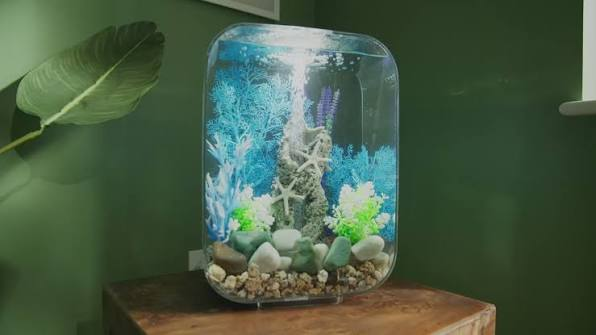
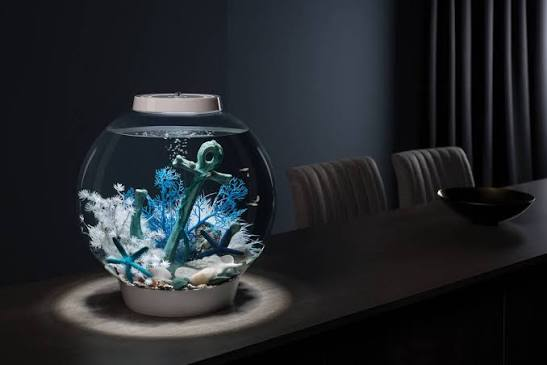
You’ve seen a biOrb fish tank even if you didn’t know the name. That glowing acrylic sphere on a sideboard, usually purple or blue, with a thin stream of bubbles. The first order came in October 2000, and by the time OASE Group bought the maker’s assets, more than a million had sold worldwide. The range has since grown to seven tank shapes, plus the plant-focused AIR and WATER lines. So is a biOrb fish tank still worth buying? My take: it looks great and goes together in minutes, but it’s tiny, and tiny tanks punish carelessness. Here’s the full picture, costs and pitfalls included.
What’s in the Box (and Which Shape to Pick)
Every biOrb fish tank comes with the lot in one carton: acrylic tank, light, air pump, 12-volt transformer, air stone, filter cartridge and ceramic media. Add water, add fish. Done, more or less.
The shapes are CLASSIC (the round original), LIFE with curved edges, HALO with a hidden waterline, FLOW, the egg-shaped LOOP, the cylindrical TUBE and the square CUBE. Capacity starts at 15 litres, about 4 gallons, and moves through 30 and 60 litres before topping out at the 105-litre CLASSIC.
Lighting is where biOrb shows off. The multi-colour models offer 16 presets, adjustable brightness and automatic day and night cycles, all from a small remote. Budget versions stick with plain white LEDs. Both are rated for around 50,000 hours. Acrylic helps as well, being light, clear and better at holding heat than glass.
The filter works differently from most. The cartridge sits at the very bottom, since waste sinks, and ceramic media around it hosts the helpful bacteria. One retailer says the surface area equals a football pitch. Take that with a pinch of salt, but the design is smart for something this size.
The Real Cost of Owning One
Buying a biOrb fish tank is cheap. PetSmart listed the 4-gallon FLOW 15 at $124.99, reduced from $157.99, and Chewy had the 8-gallon CLASSIC between roughly $116 and $127 depending on the colour. Prices shift constantly, so look again before you pay.
Keeping it going is another story. The maker claims around 15 minutes of upkeep a month using its service kit, which costs extra. Retailers say swap the cartridge every four to six weeks. Owners with just a few fish sometimes manage eight. A lot of them moan about the price of those refills, and honestly I understand why. Add conditioner, a test kit and decor and the total creeps up.
Heating is the other line item. If you want tropical fish you’ll need a heater, and the biOrb Heater Pack is a 50-watt adjustable unit covering 20°C to 33°C, with a glass thermometer. It handles tanks up to 60 litres and fits everything except the 4-gallon HALO 15. Worth double-checking before you order.
Who Can Actually Live in a biOrb Fish Tank?
Few fish. That’s the rule. One retailer guide suggests three to five small community fish in the smallest biOrb, up to eight in the middle sizes and ten to twelve in the bigger ones. Neon tetras and similar peaceful schoolers come up again and again, and the same guide aims for pH 7.0 to 8.0 and 22°C to 26°C.
Goldfish? No. The manufacturer itself says to avoid them. They’re messy, they grow large and a biOrb can’t cope.
Bettas are where reviews fall apart. One Chewy reviewer enjoys their betta more than ever in a white 4-gallon orb. Another says the tank killed two bettas before they figured out why. Same tank, opposite outcomes. I’d bet the difference was how each one was set up, and that leads straight to cycling.
Some owners also dislike the curved walls. Algae is harder to wipe off, and fish disappear around the bend, so you end up playing hide and seek just to count them. If a clear, open view matters to you, think about that.
Cycling: The Step the Instructions Seem to Rush
On the UKAPS forum, experienced fishkeepers were shocked after reading the Flow 15 instructions, which appear to allow fish roughly a day after you add conditioner and a biological booster. Their advice was a fishless cycle lasting four to six weeks. Retailer guides agree on the principle, which is cycle first, always.
Why so long? Fish produce ammonia, and bacteria need time to grow before they can deal with it. In a biOrb fish tank, 15 litres of water means ammonia builds up fast and fish suffer quickly. Test the water. Wait until ammonia and nitrite both read zero. Then add fish slowly, a few at a time. A biological booster can speed things along, but it won’t do the waiting for you.
And the noise? Opinions split. Some owners say the pump is barely audible with the lid on. One reviewer found theirs a bit loud. Standing the pump on carpet helps, and a few people replace it with an underwater model.
Quick Answers Before You Buy
Is a biOrb fish tank good for beginners?
It’s easy to set up, and retailers often point first-timers to the 30-litre CLASSIC or FLOW. But small tanks leave no margin for error. Cycle properly, stock lightly and test your water, and you’ll be fine. Cut corners and problems arrive fast.
Does a biOrb fish tank need a heater?
Only for tropical fish. Cold-water species manage without one. For tropical ones, get the 50-watt pack and a thermometer, and remember it doesn’t fit the HALO 15.
Can a biOrb hold anything besides freshwater fish?
Partly. The WATER line is built around artificial or live plants and can run with no fish at all. The 105-litre CLASSIC is sold as suitable for larger tropical or marine fish. Saltwater is a job for someone who’s kept fish before.
How often should I change the filter cartridge?
Retailers say every four to six weeks. With only a few fish, some owners stretch it to eight. Let your test results decide, not just the calendar.
So, Buy It or Not?
If you want a biOrb fish tank as a striking object that also holds a few fish, yes. Buy a biOrb fish tank for the looks, treat it as a nano tank, and it’ll be a lovely little centrepiece. If you’re after something that runs itself, look elsewhere. The orb needs a patient owner, and that’s the whole deal.