Heating season is back. Your thermostat isn’t the only thing working overtime — your fish tank heater is too. Ask any long-time fishkeeper what’s wiped out a tank, and disease usually isn’t the answer. A bad fish tank heater is. One that stuck “on” and slow-cooked everything overnight. Or one that quietly died in a cold snap while nobody was watching. Fall is exactly when a weak fish tank heater gets exposed, which makes this the right time to actually check yours instead of assuming it’s fine.
Why a $15 Price Gap Can Mean Life or Death
Most tropical fish need water between 75 and 80°F. It’s not the number that matters most — it’s the swing. A slow one-degree drift is nothing. A five-degree crash overnight usually means a failed fish tank heater. A spike into the 90s usually means a stuck one. Either way, fish get stressed, ich outbreaks follow, and sudden deaths follow. Cheap heaters cut corners in places you can’t see on the box: calibration, shutoff behavior, failure mode. A good fish tank heater gets these right. A bad one hides its flaws until it’s too late.
This is why experienced keepers treat a fish tank heater as safety equipment first. Comfort is secondary. The price difference between a reliable unit and a risky one is often just a few dollars. That gap is small compared to the cost of losing an entire tank.
How Many Watts Does Your Fish Tank Heater Need?
This is where most buyers guess wrong, usually too low, because a bigger fish tank heater costs more upfront. The rough rule: 3 to 5 watts per gallon, higher if the room is cold or drafty. A 10-gallon betta tank in a warm apartment can run fine on 25-50 watts. A 55-gallon tank in a cold basement might need 200 watts or more.
Splitting that wattage across two smaller heaters is often smarter than one large unit. If one fails, the tank drifts instead of crashing. You get time to notice and react before fish are harmed. This redundancy costs a little more upfront. It’s cheap insurance compared to replacing an entire stocked tank.
Room location matters more than people realize too. A tank near a drafty window or an exterior wall loses heat faster than one in an interior room. A fish tank heater rated for a warm room may struggle in a cold one, even at the same wattage. Always size up slightly if your home runs cool in winter.
Features Worth Paying For
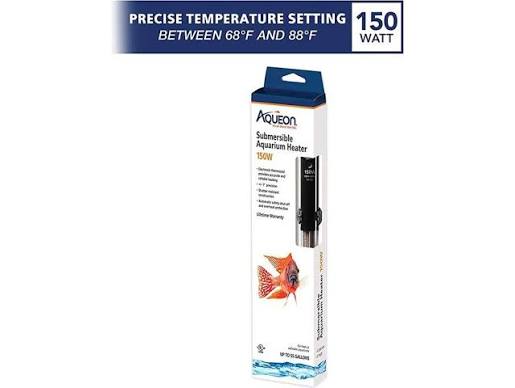
Nothing here is exciting, and that’s the point. Auto shutoff when the fish tank heater leaves the water stops a common mistake. Someone forgets to unplug it during a water change. It scorches on contact with air. Over-temperature protection caps the heat no matter what the thermostat does. This is usually built into PTC ceramic elements. Older glass-and-coil heaters can’t do this.
External digital controllers are now common even on mid-range units. They let you verify real temperature instead of guessing at a dial. The electronics also stay outside the water, away from moisture and corrosion. Most $25-50 heaters from decent brands include this now. Below that price range, safety features start to disappear fast, and that’s usually where problems begin.
A dry-run sensor is another feature worth checking for. It cuts power the moment the fish tank heater is exposed to air, even briefly. This protects both the heater and the tank glass from thermal shock. It’s a small addition that prevents a surprisingly common accident.
Titanium, Glass, or PTC?
Anyone who’s had a glass heater crack switches to titanium fast. It’s nearly unbreakable. It handles bumps from bigger or active fish without shattering. It also holds up better to repeated heating cycles than glass does over time.
Glass sticks around because it’s cheap and you can see the element inside. But it’s also the most likely material to shatter if water gets too low or something knocks against it. PTC ceramic splits the difference. It’s compact, self-limiting on heat output, and increasingly the tech inside modern controller-based heaters.
Running a canister filter already? An inline fish tank heater plumbed into the return line keeps the tank itself free of visible gear. That’s a real advantage for aquascaped or display tanks where equipment clutter is a problem. It also spreads heated water more evenly, since the return flow distributes warmth across the whole tank instead of one corner.
Where to Place a Fish Tank Heater
Placement affects performance more than most buyers expect. A fish tank heater works best near a filter outlet or powerhead, where water circulation spreads heat evenly. Tucking it into a still corner creates hot spots near the heater and cold spots elsewhere in the tank.
Horizontal placement near the substrate is common advice, since heat rises naturally through the water column. Vertical placement works too, but only if the model is designed for it. Always check the manual, since some auto-shutoff sensors only function correctly in one orientation.
Common Mistakes That Shorten a Heater’s Life
Overdriving a small heater in a large tank is one of the most frequent mistakes. It runs constantly trying to keep up, which wears out the thermostat faster. Buying a unit slightly oversized for the tank, then letting it cycle on and off normally, actually extends its lifespan.
Ignoring buildup on the heater’s surface is another common issue. Algae and mineral scale insulate the glass or titanium casing, making the heater work harder to transfer heat. A quick wipe during routine maintenance keeps a fish tank heater running efficiently for years longer.
Common Questions About Fish Tank Heaters
Do I need a heater if my house stays warm? Probably yes. Most tropical fish need water warmer than typical room temperature, even in a heated house. A fish tank heater is standard gear, not optional, for almost any tropical setup.
How do I know my heater is actually working? Don’t trust the built-in dial alone. Keep a separate stick-on or floating thermometer on the tank. Check it daily for the first week after installing any new fish tank heater, since probe accuracy varies between units.
Can I run two heaters in one tank? Yes. For tanks over 30 gallons, this is often the smarter setup. Splitting the required wattage across two units means one failure won’t crash the whole tank’s temperature.
How long does a fish tank heater last? Two to four years of steady use is normal. The thermostat degrades quietly before it fails outright. Many experienced keepers replace their fish tank heater around year three, just to stay ahead of failure.
Bottom Line
Don’t buy a fish tank heater on price alone. The failure modes on cheap units are the ones that actually hurt fish: sticking on, cracking, or shutting off silently. Size it correctly for your tank and room. Pick a unit with real over-temperature protection. Back it up with a thermometer you actually trust.
It’s boring equipment that nobody looks at. But your fish tank heater is doing more work than almost anything else in the tank, and it deserves more attention than most people give it.