If you’ve just brought a puppy home this autumn, chances are Wainwright’s puppy food is already sitting in your basket or on your screen — not because you researched it for hours, but because it’s everywhere in Pets at Home, both in-store and online. That’s basically the whole story of how most people end up with it. But “everywhere” isn’t the same as “right for your dog,” and the honest answer to whether Wainwright’s puppy food is any good depends entirely on which bag or tray you’re actually looking at. The range isn’t one product. It’s several, and they’re not close to equal.
Why This Brand Shows Up in Every Search You Do
Here’s the thing about Wainwright’s puppy food it’s not made by some independent pet food company chasing your loyalty. It’s Pets at Home’s own label, which is exactly why it has the shelf space it does. That’s also why so many new owners compare it to pricier, boutique brands almost by accident — it was just there first. So instead of asking “is it good,” a better question is which version you’re holding. Standard dry kibble, grain-free dry, wet trays, wet cans — these aren’t minor variations on a theme. The meat content, the fillers, even how clearly the ingredients are labelled, shift a lot depending on which one’s in your hand.
Standard vs. Grain-Free: The Gap Is Bigger Than You’d Think
The standard version of Wainwright’s puppy food leans on wheat as part of its carb base, and its meat percentage sits under what most reviewers would call “high meat” for a growing dog — which matters, because puppies genuinely need that protein for bones, muscles, coat, all of it. The grain-free version does something different: no wheat, no maize, no dairy, no soya, and meat content pushed above 30%. That’s not a small tweak. If you’re avoiding grains because your puppy seems sensitive, or you just want more protein in the bowl, don’t grab the standard bag out of habit — check the grain-free version of Wainwright’s puppy food specifically.
The Wet Food Actually Scores Better, and Here’s Why
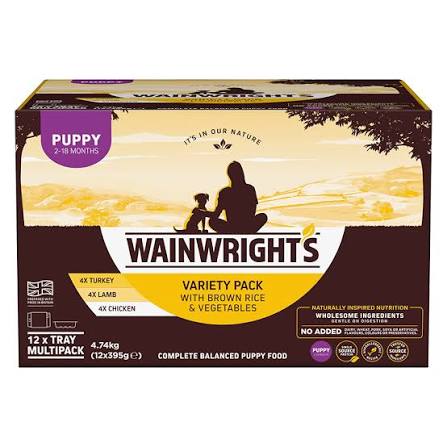
This surprises people, but the wet trays and cans in this range consistently outrate the dry kibble on independent nutrition scoring. Part of it’s just moisture — pâté-style food ends up with a higher effective meat content once you account for that. But it’s also labelling. The wet trays of Wainwright’s puppy food spell out exactly what’s excluded — wheat, maize, dairy, soya, artificial additives — no guesswork. Compare that to some of the dry recipes, which haven’t earned clear-labelling marks because the non-meat ingredients aren’t fully broken down on the pack. If you care about actually knowing what’s in the food, not just trusting the front-of-bag claims, the trays are the safer bet.
What You’re Really Paying For
Wainwright’s puppy food has always leaned on being the affordable option, and it still is — the dry kibble in particular costs noticeably less per day than most boutique brands. That’s not nothing; a puppy’s first year of feeding adds up fast, and saving money matters to most people. But the catch is that the cheaper price on the standard line tracks pretty directly with more filler and less ingredient transparency. Once you move to the grain-free dry or the wet trays, that gap closes a lot — you’re paying more than the base kibble, sure, but you’re also getting something a lot closer to what premium brands offer, at a price that’s still lower than theirs.
Before You Buy, Check These Three Things
Skip the brand name entirely for a second and just look at the specific bag of Wainwright’s puppy food in front of you. Is it labelled grain-free or standard? What’s the declared meat percentage? What age range does it cover — most of these run from weaning up to around 18 months, before you’d switch to an adult formula. One more thing worth knowing: none of this range is built specifically for breed size. If you’ve got a large or giant breed puppy, that matters, because their calcium needs and growth rates are different from a small dog’s, and a generic formula might not track their growth as well as something built for bigger breeds specifically.
A Few Things People Actually Ask
Is the grain-free version of Wainwright’s puppy food really better than standard? On paper, yes — higher meat content, no wheat, maize, dairy or soya. Whether your specific puppy needs grain-free comes down to whether there’s an actual sensitivity, but nutritionally, it’s the stronger formula of the two.
Can I feed this to a large-breed puppy? You can, technically, since nothing here is breed-size-specific. Just keep a closer eye on feeding amounts and growth if your dog’s going to be big — the wrong nutrient balance during a fast growth phase can affect joints and bone development.
Why does the wet version score higher than the kibble? Higher effective meat content once you factor in moisture, plus the trays are labelled more clearly than a lot of the dry recipes — both feed directly into better independent ratings.
Is it actually cheaper than premium brands? Yes, especially the standard dry kibble. The grain-free and wet options cost more than that baseline but still usually come in under premium independent brands.
Bottom Line
Don’t judge Wainwright’s puppy food as one thing. The distance between the standard and grain-free dry recipes — and between dry and wet formats generally — is big enough to actually change what your puppy’s eating day to day. Tight budget? The standard kibble does the job. Want something closer to premium without the premium price? Go grain-free dry or wet trays. Either way, read the specific bag, not just the name on the shelf.