Picture the scene. It’s 11 p.m., your dog has been sick on the rug twice, and the shelf of probiotic paste for dogs at the pet shop starts to look like an answer. Does it work? Sort of. The strongest evidence we have is a 2019 trial of 148 dogs, published in the Journal of Veterinary Internal Medicine: dogs on a probiotic paste stopped having diarrhea after a median of 32 hours, against 47 for dogs on a dummy paste. Fifteen hours matters when you’re mopping floors. It isn’t miraculous, though, and the tubes on sale in November 2026 vary a lot in what they actually deliver. Here’s where the science stands.
A 15-Hour Head Start: What the Best Dog Trial Found
Details matter with any probiotic paste for dogs. Vets at 14 practices in the UK and Ireland enrolled dogs with sudden, uncomplicated diarrhea. One group got Pro-Kolin Advanced, which combines Enterococcus faecium 4b1707 with kaolin and pectin. The other got a lookalike placebo. Owners gave it every eight hours, and every dog switched to a highly digestible prescription diet. Extra treatment became necessary for just 3.5 percent of dogs on the real paste. On placebo, 14.8 percent.
Before anyone gets carried away: the maker was behind this study. The placebo dogs improved as well, in about two days, because plain diarrhea often just burns itself out. Reviews of the dog research, including a 2024 one, rate the overall benefit as small. A probiotic paste for dogs, then, is a nudge. Nothing more.
What about 2026? Mostly small, early work. In January, Frontiers in Veterinary Science published a pilot of 11 dogs with chronic diarrhea who were given a probiotic built from strains first isolated from a healthy dog, among them Peptacetobacter hiranonis. The dogs tolerated it. There was no control group, so no verdict on whether it helped. In February, a paper in Animals tested two strains from canine milk in young Labrador Retriever puppies and called them safe.
Rescue Tube or Daily Tube? Three Kinds of Dog Probiotic Paste
Not every probiotic paste for dogs is built for the same moment. Rescue pastes are meant for a few days and tend to include something to bulk up stools. Nutramax’s Proviable kit has a multi-strain probiotic plus kaolin and pectin, and its label says 48 to 72 hours of paste, with sprinkle capsules on the side. YuMOVE’s Rapid paste goes up to six days, up to three times daily, from 12 weeks of age. PDSA’s tops out at five days.
Then come the everyday versions of probiotic paste for dogs. EZ-Soothe is pitched at travel, kenneling, training, and the weeks after antibiotics or deworming. Some brands skip bacteria and use yeast: FullBucket lists 12.5 billion Saccharomyces boulardii, Dogzymes 2.3 billion CFU per gram of it.
And a few products only look the part. Zesty Paws’ bacon-flavored Probiotic Paste Pill Wrap exists to disguise tablets, so it won’t do what a diarrhea paste does. Check flavors, too. One chicken-flavored gel warns against use in dogs with poultry allergies.
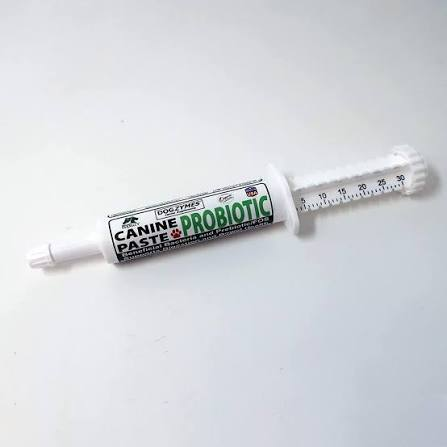
Why “Billions of CFU” on the Label May Not Mean What You Think
Here’s the uncomfortable bit. In 2011 the Canadian Veterinary Journal published a lab check of 25 veterinary probiotics. Live counts ran from zero to two billion CFU per gram. Fifteen products made specific claims about viable organisms; only four lived up to them, and two of those had decent labels as well. A 2020 look at pet kefir was no better: every product with a guaranteed count overstated it by at least tenfold.
Strain is the other trap with probiotic paste for dogs. Effects belong to a specific strain, but plenty of labels name only genus and species. The count printed on the tube is usually measured when it’s made, not when it’s swallowed. And because probiotics count as supplements, not drugs, nobody has to show they work first. People often quote 1 to 10 billion CFU a day as a sensible target. Honestly, the ideal dose for dogs hasn’t been settled.
So shop like a skeptic. You want the full strain name, a live count guaranteed to the expiry date, storage rules you’ll really follow, and ideally a published dog study on that exact strain. “Proprietary blend”? Put it back.
Red Flags That Mean Put the Tube Down and Call the Vet
A paste is for easy cases. Cornell’s veterinary school says to get help if your dog stops eating, goes weak, vomits, passes black or tarry stool, or hasn’t improved after 48 to 72 hours. PDSA is stricter: ring the vet if it’s gone past 24 hours, or if the dog is very young, on medication like NSAIDs, or has a health condition already.
Puppies change fast. Weak, refusing food, vomiting, blood in the stool? Skip the probiotic and go to the vet. Same caution for dogs with weakened immune systems, including those on chemotherapy: probiotics only with a vet’s say-so.
Side effects are usually minor and short, like a dip in appetite or a bit of nausea. Antibiotics are where things get messier. One 2019 study found fewer digestive problems in dogs given a probiotic blend; another trial found that a probiotic-and-yeast mix kept dogs eating but didn’t stop the upset stomach. Ask your vet before you combine them.
Four Questions Dog Owners Keep Googling
Can I give my dog probiotic paste every day?
Usually, yes. Daily use is considered safe for most dogs, and some pastes are designed for it. Rescue formulas aren’t: their labels ask for short runs of roughly two to six days. Follow your product’s directions, and check with your vet first if your dog’s immune system is compromised.
How quickly does probiotic paste work?
In the 2019 trial, diarrhea cleared in a median of 32 hours on paste versus 47 on placebo. Think a day or two. If nothing has clearly improved by 48 to 72 hours, call the vet.
Can I use a human probiotic or yogurt instead?
Probably not. People and dogs share some gut bacteria, but benefits depend on matching strains to the host species, so a dog-specific product is the safer bet. Ask your vet before offering Yakult or kefir.
Is probiotic paste safe for puppies?
Some can. YuMOVE’s probiotic paste for dogs starts at 12 weeks, and vets sometimes recommend puppy-specific formulas. But a puppy with diarrhea that’s weak, off its food, vomiting or bloody needs a vet straight away.
The Bottom Line on Tummy Trouble
Probiotic paste for dogs earns a spot in the cupboard if you treat it modestly: mild diarrhea, a stressful trip, a boarding stay. One decent trial supports it, and a lot of marketing surrounds it. Choose a product with a strain you can look up and an honest label, give it 48 to 72 hours, and call the vet if your dog isn’t better by then.